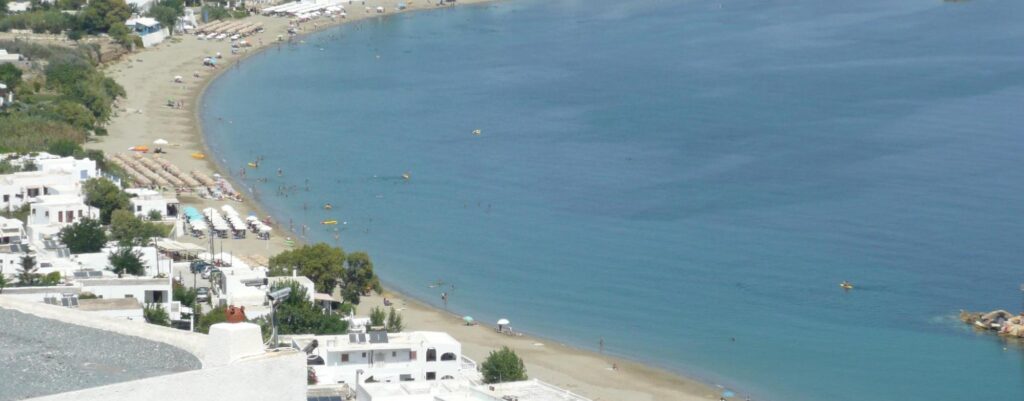
This article is written by John Greeves, a self-professed writer and journalist who has visited Skyros at least five times over the years. He enjoys the inclusiveness, ethos and community Skyros offers to its participants.
“There’s something magical about the island, the community and the Spirit of Place which draws you back again and again.”
We are all aligned with certain places. The Classical world recognised it as ‘Spirit of Place’ or genius loci. The genius loci was a pervading and protective spirit of place which persisted through many religions. A longing for place has endured through many cultures. The Greeks refer to nostos (Home coming or return), while the Welsh express hiraeth (longing for their homeland), the Germans, Fernwch (far sickness), the Russians Toska (Spiritual longing) and the Dutch Heimwee (home sickness) when it comes to this particular yearning of place.
This isn’t surprising as we often feel a visceral association with certain places like Skyros. The island holds a personal meaning for many of us and we feel drawn continually to its shores.
What writers say
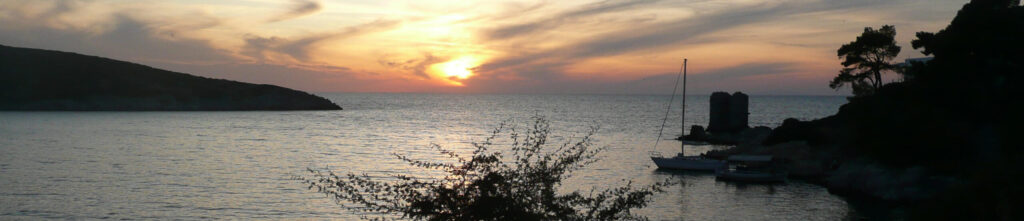
D.H Lawrence wrote: “Different places on the face of the earth have different vital influence, different vibration, different chemical exhalation, different polarity with different stars: call it what you like. But the spirit of place is a great reality.” For many, the island of Skyros provides an emotional anchor and a creative impetus for many participants who return like migrant birds year after year, to quell their yearning for this place.
The novelist and island writer Lawrence Durrell believed landscapes were the important determinant of any culture. For him the Spirit of Place often referred to the unique atmosphere, character, or perceived “guardian spirit” of a particular locations, which profoundly influenced the artist and writer. He believed great books were rooted in nature and that a ‘sense of place,’ was the key criterion for greatness rather than just character and plot.
Writers, for instance, such as Emily Bronte used the wild landscapes of the Yorkshire moors to convey the foreboding atmosphere of Wuthering Heights. Others too like E.M Forster, J.R.R. Tolkien, George Orwell and artists like J.M.W Turner, John Constable, Paul Nash and Claude Monet, have also succumbed to the Spirit of Place in their creative endeavours. Durrell argues that one doesn’t fully understand the true nature of a place through factual information alone and it must be embraced more through a sensory, poetic and instinctual connection.
Just as the term ‘relativity’ has crossed various disciplines, the notion of the Spirit of Place has been adopted in humanistic geography architecture, landscape design, planning, conservation and design and raises the question as to whether the concept has evolved more in its scope.
More than a passive back drop
Durrell viewed landscape not as a passive backdrop but more importantly as a living influence in shaping the daily lives of people, particularly on islands.
“Human beings are an expression of their landscape,” he claims. I see this in Skyros, in the traditional cube like houses which step up the prominent rocky escarpment to the town above.
These small traditional houses were often built with two rooms and a small upper mezzanine platform (called a soufa) for a bed. They were thick walled, warm in winter and cool in summer and built with local materials with roofs originally made with a composition of mélange (type of clay) and sea weed.
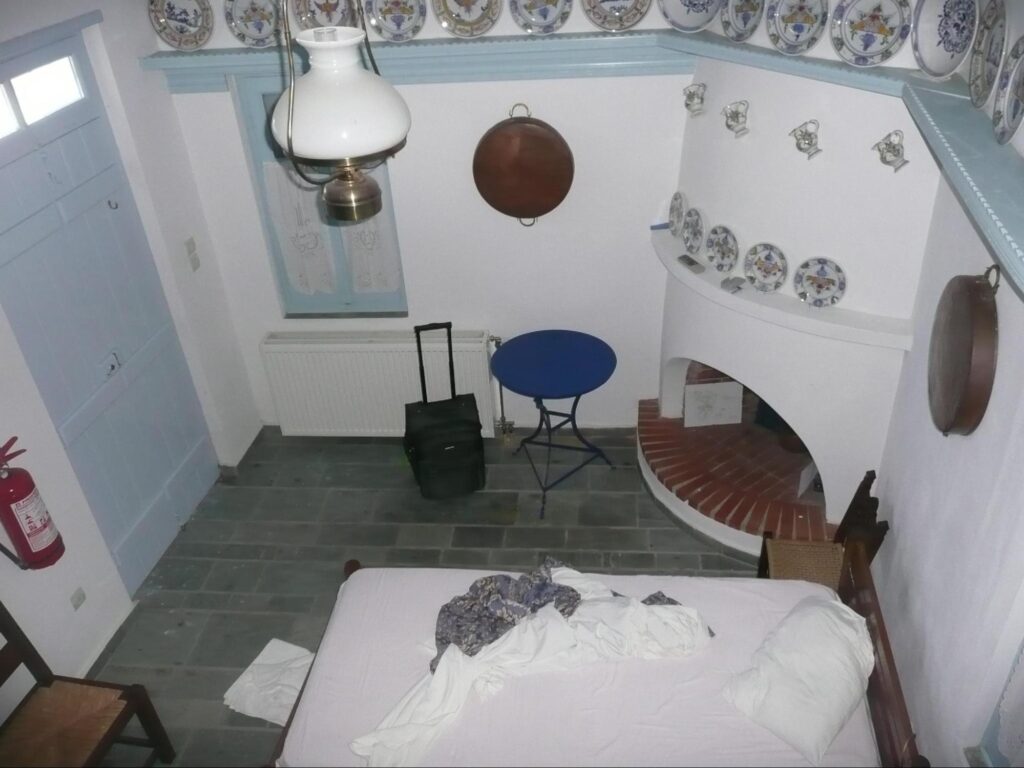
Located on steep terrain of Skyros, these white washed houses were clustered close together for protection. Salt and water added to the lime were mixed to make the lime mix, which not only deflected the sun but acted as a natural antiseptic. It is only in recent years that blue has been used to reflect the symbolic colour of the national flag. These early houses were designed with small windows, with a labyrinths of pathways to make them more defensible against sea pirates and unwelcome incursions and are very much a product of landscape and environment.
Environmental determinism
Skyros it seems follows this pattern which Durrell puts forward and has been determined as much by the landscape as by the climate, with the barren and rocky south side of the island remaining largely uninhabited while the populated north in contrast with richer fertile soils continues to supports olives, grapes, fig, citrus lemon and orange trees, pomegranates and even apricots. In the forests, Pine, Holm oaks., Cedar, Maples (juniper) grow. Seasonal vegetables like chard, split peas, spinach, cucumbers and aubergine are also grown, while sage, thyme, oregano and wild laurel also thrive.
Durrell believed that specific locations especially in the Mediterranean possess a unique character, a truth of the place, that determines the nature of the people, history and the art. Skyros of course is in the Aegean but shares similar characteristics to the Mediterranean. Durrell went on to coin the term Islomania (see Prospero’s Cell) to describe a specific love for islands, which he saw as microcosms where the Spirit of Place was more concentrated.
Past and present are one
Over the millenniums, Skyros has suffered from the onslaught of invaders including: the Athenian, Romans, Goths, Byzantine, Venetian Ottoman and Turks. The wells, mosques and cemeteries may have disappeared but other tangible markers still exist in the language, Greek coffee, cuisine, folk art, dance, music and even the traditional costumes of the island.
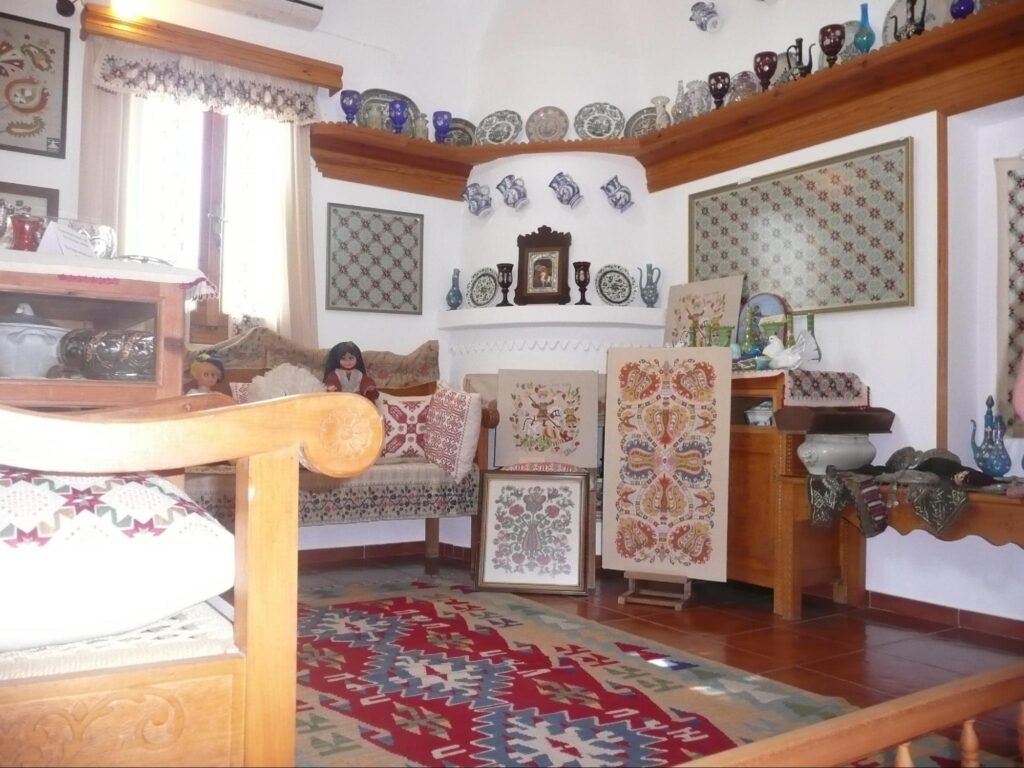
Embroidery on Skyros, also exhibits strong links to an ancient past and place, featuring motifs and techniques—such as the “stahi” stitch—that have been passed down through generations. These designs, often adorning local costumes and homes, reflect themes from the sea, natural landscape, and local mythology.
Other indicators exist like the Skyrian Goat Festival which tie the present with the past on Skyros. The festival has its roots in the Dionysian celebrations of ancient Greece and shows the present is just a continuum of the past. Three weeks before Lent a young man wraps himself in goatskins and 50 kg of goat bells. This half human, half animal totem whirls himself around in order to release Persephone and bring on the Spring and dances in the streets with an ancient, wild and primitive abandonment. The entire community joins in this street party and good-humoured merriment fills the day with music and dance.
This goat festival is probably a survival of a fertility rite performed at the end of winter to ward of evil and promote fertility and relates to a totem animal which through the ages has sustained the island economy through its milk, meat, blood and hide for countless generations.
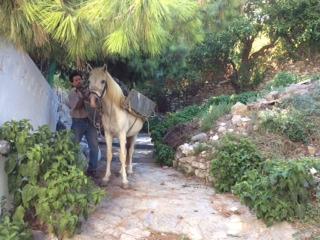
Other visible reminders link the present with the past in this on going story of Skyros island. The rare Skyros horse is still found on the island and is widely believed to be a direct descendant of the ancient, small-bodied horses depicted on the Parthenon frieze in Athens. These ponies likely migrated to Greece 12,000 years ago and were possibly brought to Skyros by Athenian colonists in the 5th century B.C.
Stories too, remain woven into the island’s fabric about Achilles and Theseus. An ancient prophesy proclaimed that Troy, would only fall if Achilles took part but in turn he would die. Thetis his mother thought she could change the future by disguising him as a girl and hiding him amongst the seven daughters of King Lycomedes. However Odysseus decided to trick Achilles into revealing himself and so the prophesy came true. Theseus too lived in the late Bronze Age, about a generation before the start of the Trojan War, The most famous myth involving Theseus, the slayer of the half man, half bull Minotaur. King Lycomedes was responsible for his betrayal and death and threw him off a cliff in Skyros.
An evolving concept in which we discover our own personal truth
I wonder if I’ve become too beguiled like Odysseus by the Spirits of Place. Scientists generally oppose the idea of the concept of the ‘Spirit of Place’ feeling it relies too much on subjective, non-physical and what they claim is often untestable assumption. However this view doesn’t satisfy me. I believe the meaning has shifted over the centuries from the genius loci to an interdisciplinary understanding of the tangible and intangible qualities of a location. It’s impossible too for scientists to ignore the measurable psychological and emotional reactions place has on human beings, whether you call it ‘place attachment’ or understand it more in a generic poetic and literary sense it still has meaning. Sadly, reductionist science often discounts the whole in its perceived view and underlines its own limitations.
For me, place still holds a deep personal truth. I still experience what can be termed the ‘Spirit of Place,’in special locations. It’s a feeling of awe and attachment… sometimes of wonderment, a pause in my hectic existence, as well as a feeling of continuity or connection with the past. It stimulates creative energy, provides a time of reflection and a place to feel as one in this very unpredictable world. I wonder what it’s like for you?
What might Skyros mean to you?
Discover a holiday shaped by creativity, community and the freedom to follow your own interests.