
A participant’s story: visiting Rupert Brooke’s grave on Skyros
In this guest blog, John Greeves shares his own journey across Skyros to Rupert Brooke’s grave, weaving together the island’s landscape, history and his reflections along the way.
Brooke Square and the road south
‘So you are going to meet the Englishman,’ the taxi driver says as we speed up towards Brooke’s grave. Earlier that day I climbed high up in Skyros town to ‘Brooke Square,’ to find a statue to ‘Rupert Brooke and immortal poetry.’ The statue holds a parchment in his right hand, but the quill is apparently missing from the left. Today the bronze figure looks down to the white laced Aegean sea framed with beaches and tavernas along its curving shore.
The naked statue, originally called “Youth,” caused considerable controversy when it was unveiled on April 5, 1931. Many local people considered it indecent despite the event being attended by the Greek Prime Minister and approximately one hundred and twenty scholars, journalists, artists and intellectuals, many from abroad including André Gide the celebrated French author
The statue is an allegory, modelled initially on a ‘male prostitute,’ in Athens. Nowadays opinions have changed and local Skyrians now refer to the work as ‘The statue to immortal poetry,’ which seems to resolve something of its tarnished character and its association with Rupert Brooke

lies in the sparsely populated area of the south west of the island. From my map, Skyros appears to be divided into two nearly equal parts by a low-lying isthmus with ‘Tris Boukes Bay,’ (Bay of the three mouths) being one of its natural harbours. The north of the island in contrast is more fertile with forests of oak, pine and beech in parts; but here in the south the land rises, treeless, arid and rock strewn…a hostile beauty unchanged from ancient times
The grave and its setting
Rupert Brooke’s grave is in a valley and lies between two adjacent peaks and is overlooked by Mt.Kochilas the highest point on the island. I’ve read the original grave was a cairn of rocks of pink and white marble gathered from the stony ground, which was heaped into a long tumulus. Two wooden crosses were raised, one at the head and the other at the foot of the grave. The inscription read
RIP IN MEMORY OF RUPERT BROOKE- DIED 23rd APRIL 1915, AGED 27.
Brooke died on St. George’s day and was buried on land belonging to the monastery of St. George. On the back the cross bore an inscription in Greek, which translated as:
Here lies the servant of God, Sub-lieutenant in the English navy, who died for the deliverance of Constantinople from the Turks. A rather spurious claim at best, as he never saw active service in Gallipoli.
A more permanent grave was erected later in 1920, following the request of Brooke’s mother who feared for the permanency of the make shift grave.
The new construction was hard work and took nearly three weeks to complete. Stanley Casson, Assistant Director (1920-1923) of the British School of Athens (which sometimes facilitated archaeological field work) was charged with the responsibility of erecting the new grave. Pentelic marble slabs had to be unloaded on shore and then transported up the rocky incline to the isolated spot.
Access to the graveside until fairly recently, was only by sea or goat track and was never easy at the best of times. Local masons then had to be found. The nearest village was fifteen miles away and a path had to be hewn to the new place of work. The only accommodation to be sought according to Casson was in a shepherd’s hut. I’m wondering if the pale anemones, orchids, blue hyacinths and sombre russet fritillaries, which he describes, will still occupy this land… and whether the smell of wild thyme and mint still permeates the air

A hard road and older echoes
The taxi lurches forward, a herd of goats suddenly appear in front of us. The driver doesn’t slow down. Instead he cuts through them like a speedboat, jettisoning a v shaped wake on either side. Luckily all survive. The poet Andrew Motion (former Poet Laureate) recalls his first attempt to find the site in the summer of 1967 when he was fresh out of school. It took him and his companion 20 hours. He and his friend got lost, ran out of water, thought they would die, but were rescued by a ‘shepherd fellow,’ who showed them the way. Andrew Motion recalls ‘When I got to the grave I remember seeing a large column of ants marching out of a crack in the marble and thinking; ‘Well there goes the last of Rupert Brooke
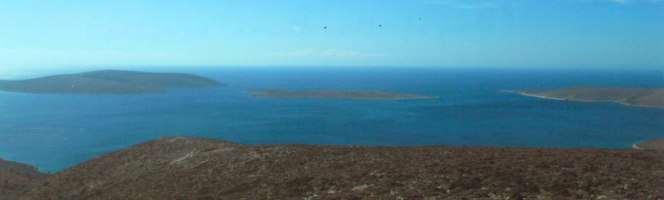
I’m not worried about ants. I’m blown away with the raw beauty of this place. I ask the taxi driver to stop. He lights up another cigarette and I get time to consider the view. When Brooke was on Samoa he made a pilgrimage to R.L. Stevenson’s grave on a step hill above Vailma. ‘It’s a high and lovely spot,’ he said. Brooke’s word would fit this place equally, as you look out at the two islets of Sarkino and Platina and the shoreline, which creates one of the greatest natural harbours in the Aegean. The intensity of earth, air and sea, shimmered here in radiant blues and threads of gold and silver is bewitching. You can imagine this war time pageant of warships with names like the Royal George, Prince Edward, Le Ville de Carthage, Canopus, Dartmouth, Franconia…huge indomitable, grey mottled outlines, surrounded by numerous transports and supply ships as well as ships from other nations with flotillas of small boats bustling all around them. The echo too of an anchor chain, stokers shooting adders on the uplands and morning reveille, echoing beneath the mountainside. Suddenly the moment is gone, the driver stubs out his cigarette and looks towards the car. “Entáxei,” I say.
Rupert Brooke’s last days
In September 1914, Brooke joined the Royal Naval Division (RND) as a sub-lieutenant and within a month participated in the evacuation of Antwerp. Back in England, during the Christmas holidays, he wrote his famous war sonnet, ‘The Soldier.’ This was originally entitled ‘The Recruit’ and was published in ‘New Numbers,’ by Wilfrid Gibson who changed the title. In February, Brooke joined the Division’s Hood Battalion in preparations for the landings at Gallipoli
Passing through Egypt on his way to Gallipoli, Brooke suffered sunstroke and dysentery. He always had a weak immune system. Recovery was slow, but he was determined to continue, even though he was offered a desk job at the time. Brooke’s troopship the ‘Grantully Castle,’ headed for Lemnos, but there were so many ships anchored off that island that his company was sent on to Tris Boukes Bay off the south west of Skyros. They arrived there on Saturday 17thApril, where Brooke received a letter enclosing a cutting from ‘The Times’describing how his sonnet ‘The Soldier,’ had been read by the Dean of St. Paul’s Cathedral (5thApril) as part of his sermon on Easter Sunday
Brooke and his fellow officers spent the following days with their men on exercise. On Tuesday 20th April, during a long day on the island, they rested in the olive grove where the grave stands. Brooke had been handed a rough map of the island and it was here he added other features to it. It was a hot afternoon and several of the officers enjoyed a respite in the shade of the trees
‘He liked the place and spoke of it,’ Browne wrote afterwards. After operations, two of his fellow officers decided to swim the mile back to the ship. Brooke declined. That night Brooke retired early with a swelling to his lip. The following day the swelling had increased and he was suffering from head and back pains. Brooke’s condition worsened and he was moved to a French Hospital Ship (Duguay Trouin) where he died at 4.46 pm. on the 23rd April 1915 from septicaemia caused by a mosquito bite
The funeral on Skyros
They decided to bury him on the island. There was little time to lose as the fleet was leaving early next day at 6 am for Gallipoli. A coffin was prepared; Brooke’s name was burnt into the wood using a cauterising iron and then covered with an English flag and placed on deck on a rectangle of palms. On it French officers laid a bunch of flowers collected from the island. Later the dead man’s pith helmet, holster, and pistol were placed on top.
The funeral took place at night.
W.C. Denis Browne, also an old Rugbeian, friend and fellow officer (Killed at Gallipoli) described in a letter to Mrs. Brooke, the scene of her son’s burial
‘We found a most lovely place for his grave, about a mile up a valley from the sea, an olive grove above a watercourse, dry now but torrential in winter. Two mountains flank it on either side and Mount Khokilas is at its head. We chose a place in the most lovely grove I have ever seen, or imagined, a little glade of about a dozen trees, carpeted with mauve flowering sage. Over his head droops an olive tree, and round it is a little space clear of all underground…He once said in chance talk he would like to be buried on a Greek Island. He could have no lovelier one than Skyros, and no quieter resting place

There was a torch lit procession, men with lamps and twelve bearers, mainly Australians in their broad brimmed felt hats, who carried the coffin up the rocky slope of the dried up river to the digging party ahead. Progress was slow, it took two hours, as they slipped and stumbled and jolted their burden. Marble pebbles turned under their feet as their heavy laced boots pressed the aromatic shrubs releasing a bewitching odour into the air. Not a village, house or road could be seen in sight
Patrick Shaw Stewart (killed at Welsh Ridge 1917) commanded a guard of honour. The moon remained cloudy as the chaplain performed the service, a slight breeze stirred in the foliage; three volleys were fired into the air, startled goats were heard jingling away and Malachi William Dewey, the 18 year old bugler sounded the last post while the scent of wild sage hung in the air.
Finding the grave today
The taxi carries on. It’s not long before the dried up riverbed leading all the way down to the shore is seen. It’s marked as broken blue lines on my map.
The car draws up along side a perimeter fence. It’s now a Greek naval base at the end of this road. A sailor clad in white comes to talk to the driver who points to towards the path leading to the grave. At one time in the nineties there were fears that the grave would be made off limits to visitors if it had come within the confines of the military establishment. Luckily it’s situated 50 metres outside
Today, the path seems well worn and dusty, the tomb pristine in its marble edifice and green railings beneath the olive grove. There’s a Toyota pick up at the side of the road and two shepherds, one with a wooden crook reminiscent of a nativity play grasps a goat, which the other tags it before its explosive release
Myth, man and memory
It’s a reflective moment as I look at the grave.
Is this myth or man?
In 27 years Brooke had many achievements; established poet, travelled the world, appointed fellow of Cambridge, army officer who had passionate affairs with several women. Yeats described him as ‘the handsomest young man in England.’ He was charming, intellectual, witty and universally sought in the society of his day. He mixed with major political and literary figures: Churchill, Violet Asquith, G.K. Chesterton, Henry James, Virginia Woolf, John Masefield, William Butler Yeats, Bernard Shaw, James Barrie and was regarded by many as one destined for greatness. Churchill hailed him as one of ‘England’s noblest sons.’
This guest blog was written by John Greeves, all image by John Greeves – with thanks from Skyros Holidays